
Introduction
The River Nile has had a remarkable history in shaping the civilization of the ancient Egyptians. People decided to live along the banks of the river because of the fertile soil deposited along it. The soil could support agricultural activities such as growing crops. The river also enabled people of the civilization era to acquire vital shipbuilding skills. The pyramids, enormous architectural feats that stand as iconic symbols of their civilization, were built partly because of the Nile. Besides its obvious practical importance, the mighty river also molded the ancient Egyptians’ spiritual beliefs and cultural practices. River Nile significantly affected the ancient Egyptians’ religious, trading, agricultural, and social structure and led to early civilization.
Impact on Land Segmentation
River Nile was vital in determining how the Egyptians segmented the land. They divided the land into Kemet, which meant the black land (Peake and Robb 3). In Kemet, there was enough water, and the soil was fertile, which could support many agricultural activities. In this region, there was plenty of food, and thus, cities could thrive in this area. Kemet was close to the Nile River, where fertile soils were deposited.
The ancient Egyptians divided the land into Deshret, which meant red land (Peake and Robb 3). These were hot and dry areas in the desert with poor soil and no water, and they could not support farming. The Egyptians associated the Nile Valley with the oasis in the desert life and plenty, while the deserts were linked to violence and death. Therefore, the deserts provided an ideal location for the ancient people to build cemeteries.
The Egyptian land was categorized into two: upper and lower Egypt due to the Nile. These two lands significantly differed in the economic activities that happened there since ancient times. Lower Egypt is located in the north and was occupied by the Nile Delta, while upper Egypt is found in the south. These locations reflect the flow of the Nile, which is from the south to the north (El-Shazly 2).
Fertile soils were deposited in the vast lands of the Nile Delta in ancient times, which encouraged dense population settlement. Thus, the delta became a vital agricultural point for the early Egyptians (El-Shazly 2). The Nile Delta became a critical entry point into Egypt, making it an important area for trading and international connections. The delta made Egypt become a multicultural region through the entry of foreigners.
Role in Agriculture
The Nile River was crucial in making Africa habitable for the early farmers. The ancient Egyptians gave the Nile the name Aur, which means black, alluding to the rich, dark silt that the river transported from the Horn of Africa into the Nile Valley during floods (Angelakιs et al. 4). Figure 1 depicts an ancient drawing showing River Nile and its banks.
The Nile Valley was transformed from arid wilderness into fertile farmland by the Nile, allowing the rise of Egyptian civilization in the middle of a desert. A natural wonder, the Nile Valley’s heavy silt covering turned into a highly inhabited agricultural nation. The flooding marked the first month in the Egyptian calendar, indicating how the Egyptians valued the river.
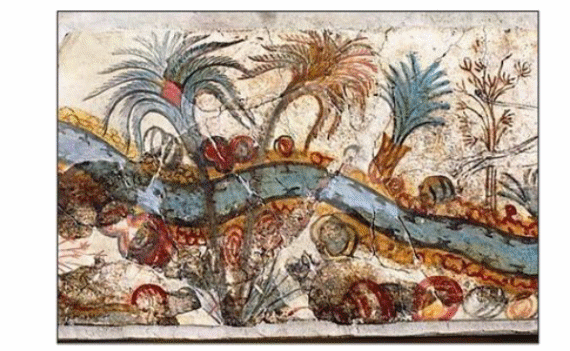
The Egyptians were the first to practice large-scale farming and grew crops such as flax and barley. The abundance of water from the River Nile facilitated basin irrigation, making it easier for them to grow crops. They dug channels into the flooded waters, which helped direct the water to their plantation fields, and this made the growing fields saturated with water (Angelakιs et al. 4). Thus, growing crops in the middle of a desert was easier due to the presence of the River Nile. To predict if they were at risk for flooding, the Egyptians built nilometers and stone columns to help show the water level. It made them make the appropriate changes, such as migration to safer fields, which would help save lives and reduce losses incurred due to poor harvesting.
Role in Transportation
The Nile was crucial to ancient Egyptian transportation of agricultural produce. Due to this, Egyptians developed into masterful shipwrights, capable of constructing big wooden ships with sails and oars (Halim and El Weshahy 126). The smaller boats were constructed of papyrus reeds linked to wooden frames for shorter journeys. Cattle, bread, vegetables, fish, and timber are all seen being transported by water in Old Kingdom artwork.
Egyptian monarchs and nobles were often buried in vessels of such high quality that they might have been utilized for navigation on the Nile. If the River Nile had not been in Egypt, the early civilization of shipbuilding in Egypt could not have happened. The transportation in the river thus made agriculture more efficient as farmers could transport their produce to more convenient places.
The Building of the Pyramids
The Nile also influenced the construction of enormous monuments, including the Great Pyramid of Giza. Massive slabs of limestone were delivered by boat down the Nile and then directed via a network of canals to the worksite of the pyramid building (Sheisha et al. 1). Carrying and rolling huge stones over the land would have been an impossible and tiresome task during the ancient period. Even though the Nile and the pyramids are far away in modern times, there is evidence that a tributary existed connected to the pyramids’ construction site.
The scientists pieced together the history of the Khufu branch, a once-important tributary of the Nile, from hints buried in the arid soil. Scientists suggest that the branch dried completely around 600 BC and played a vital role in building the pyramids (Sheisha et al. 2). It concludes that the pyramids would not have been constructed without the River Nile.
More evidence exists that a tributary once connected the River Nile to the Giza. Some of the manuscripts were written during the time of Khufu, describing how an official called Merer and his soldiers brought limestone from the southern Nile to the Giza pyramid site (Sheisha et al. 2). The researchers recovered sediments along the way, suggesting that Rive Niles’s tributary was once connected to the pyramids. The scientists suggest that after the construction of the pyramids, the Khufu tributary dried beyond usability.
The river declined for decades until King Tutankhamun assumed power around 1300 B.C. (Sheisha et al. 1). A cemetery had been established on the dry land near the Khufu branch by the period Alexander the Great invaded Egypt in 330 B.C (Sheisha et al. 1). These provide evidence that the Nile played a massive role in building the pyramids.
Impact on Shaping the Egyptian Calendar
The River Nile played a significant role in shaping the calendar of the ancient Egyptians. The calendar mainly encompassed three seasons: Akhet, Peret, and Shemu (Abdel-Ghaffar et al. 238). The floods of the Nile occurred during Akhet, while the growing and harvesting seasons occurred during Peret and Shemu, respectively. The Egyptians used Nilometers to keep track of the yearly inundation’s height. They relied on the Nilometers’ data collected in the same way that modern farmers rely on almanacs. The Nilometer on Elephantine Island near Aswan is remarkably well-preserved.
Impact on Religion
Due to their longstanding relationship with the Nile, the Egyptians connected several deities with the river, the yearly flood it caused, and the bounty and prosperity it brought. For instance, Hapi personifies the Nile’s life-giving energy and represents the river’s yearly flooding (Ugwu 75). His plump, flabby body is a visual representation of plenty. Even though Osiris is most often known for being the afterlife god, he is a deity of renewal and rebirth. The black complexion was used to symbolize the Nile River’s fertile silt and tie him to the depictions of him by artists. Egyptian religion also drew influence from nature as people were amazed by the order in the universe.
The flooding in Egypt caused by the river Nile had an impact on the religion that people practiced. It gave birth to the belief in gods and a social stratification system in ancient Egypt. Ra and Osiris were among the gods considered by the ancient Egyptians to be at the top of the social structure (McDonald 256). The Egyptians believed that these gods were in control of the universe and they were the supreme being. The Egyptians tried their best to make these gods happy. If the gods were happy, the Nile would flood, leading to an abundance of harvest and consequently avoiding famine in the region.
After the gods, the pharaoh was believed to be the second in line in the social stratification. They believed that the pharaoh was a god even though he was mortal. The pharaoh had power over the Egyptian land even though they required protection from soldiers and other government officials. The scribes, merchants, farmers, and artisans had a higher social stratification than the enslaved people.
The Role of the Nile on Trade
River Nile significantly impacted trade in the ancient period by allowing the region access to many other regions. Trade has played a crucial role in propelling global economic growth and civilization. The necessity to buy from and trade with other nations is inevitable. For the most part, this was the case in ancient Egypt. Despite its wealth, Egypt needed to engage in international commerce to get the goods it did not have.
Ancient Egypt was well-positioned to engage in international business with nations like Canaan, Lebanon, and Nubia in the fifth century BCE (Ahmed et al. 2). The nation’s advantageous geographical position had a significant role in the prosperity of its commerce during the period. During the period, Greece was situated north and west of Egypt, making Egypt a trading partner (Ahmed et al. 3). The vast lands of Mesopotamia, Persia, and Yemen bordered Egypt. The ancient Egyptian economy thrived primarily due to the transport the River Nile offered to transport goods and people.
Social stratification was crucial for the civilization of Egypt. Enslaved people were used to building infrastructure like the pyramids while the farmers produced food for the community (Adamopoulos and Syrou 2). The other social stratification levels were granted responsibilities such as defending the communities, producing trading commodities, and engaging in trades. These activities marked the civilization in Egypt, and the River Nile played a crucial role in the success of these civilization activities (Ahmed et al. 4). It facilitated the agriculture and transportation of the products to the appropriate destinations. Additionally, it helped transport trading goods to different parts of Egypt and the Nile Delta for export.
Adequate food for export was produced in Egypt due to the presence of the River Nile. Due to this, Egyptians were able to export food and sustain most of the Mediterranean. Ancient Egyptians were very successful merchants who contributed to Egypt’s economic growth (Ahmed et al. 2). Canaanite pottery and building materials, Palestinian oil jars, Anatolian tin and copper, and Mediterranean olive oil were all shipped to Egypt (Ahmed et al. 3).
Even with prosperous commerce, ancient Egypt still needed a lot of wood. While the Egyptians did plant trees, none of them ever bore the high-quality wood that would have been required to build their landmark pyramids and temples. It is why they had to travel to Lebanon to get additional timber. River Nile provided a means of transport for these imported and exported goods. Therefore, the River Nile played a critical role in trade civilization in ancient Egypt.
River Nile played a huge role in connecting Egypt to the rest of the African nations. The Kush monarchy had trading connections with the ancient Egyptians (Cox and Thompson 80). Due to these connections, the Nubians and the Kush participated in trading activities. There were commonalities between these communities’ political structures, religious tenets, and cultural practices.
The Nubians constructed pyramids, much like the Egyptians. They also followed the Egyptian religion and practiced mummification. The ancient Nubians mostly traded with the early Egyptians for gold and iron (Cox and Thompson 80). The Egyptians could more easily interact with the rest of Africa because of these shared characteristics.
The Nile River served as the link that joined Egypt’s commercial sector. Along the Nile, ships and boats carried various items to various ports for sale. After being unloaded, commodities were moved over different routes by camel, wagon, or foot. The Egyptians were enthusiastic about promoting their commerce and making it easy for their western and eastern commercial partners to communicate with one another.
Conclusion
Without the River Nile, most of the early civilization activities in Egypt could not have happened. Egypt became one of the first nations to practice large-scale farming due to the river. The farmers could easily transport their produce due to the presence of the river. The Nile also made the ancient Egyptians develop skills such as shipbuilding which facilitated water transport during the ancient era. The river opened Egypt to many nations globally, leading to enhanced trading activities. The traders could transport their trading commodities by water.
The Nile facilitated the construction of the pyramids of Giza as the building stones were transported by water. The river impacted the religious activities of the ancient Egyptians, and they started believing in gods. The Nile shaped the way the Egyptian calendar was organized into three seasons. It impacted the settlement patterns in Egypt as people preferred settling along the river and at the delta due to the fertile deposition of soil that supported agriculture. The river influenced the division of Egyptian land into Deshret and Kemet. These had a greater significance to the Egyptians in determining the settlement.
Works Cited
Abdel-Ghaffar, Fathy, et al. “Nile River, Impact on Human Health in Egypt from Pharaohs until Now.” Parasitology Research Monographs, 2019, pp. 237–77, Web.
Adamopoulos, Ioannis Pantelis, and Niki Fotios Syrou. “Workplace Safety and Occupational Health Job Risks Hazards in Public Health Sector in Greece.” European Journal of Environment and Public Health, vol. 6, no. 2, 2022, pp. 1–13, Web.
Ahmed, Abdelkader T., et al. “Egyptian and Greek Water Cultures and Hydro-Technologies in Ancient Times.” Sustainability, vol. 12, no. 22, Nov. 2020, pp. 1–26, Web.
Angelakιs, Andreas N., et al. “Irrigation of World Agricultural Lands: Evolution through the Millennia.” Water, vol. 12, no. 5, 2020, pp. 1–50, Web.
Cox, Gerry R., and Neil Thompson. “Nubia (Kush).” Managing Death: International Perspectives, 2022, pp. 79–83, Web.
El-Shazly, Mohamed M. “The Impact of Some Anthropogenic Activities on River Nile Delta Wetland Ecosystems.” Global Journal of Ecology, 2019, pp. 1–7, Web.
Halim, Sarah, and Mofida El Weshahy. “Boats Representation in the Byzantine Art.” Journal of Association of Arab Universities for Tourism and Hospitality, vol. 20, no. 4, 2021, pp. 124–58, Web.
McDonald, J. “Influences of Egyptian Lotus Symbolism and Ritualistic Practices on Sacral Tree Worship in the Fertile Crescent from 1500 BCE to 200 CE.” Religions, vol. 9, no. 9, 2018, p. 256, Web.
Peake, Lewis, and Cairo Robb. “Saving the Ground beneath Our Feet: Establishing Priorities and Criteria for Governing Soil Use and Protection.” Royal Society Open Science, vol. 8, no. 11, 2021, pp. 1–27, Web.
Sheisha, Hader, et al. “Nile Waterscapes Facilitated the Construction of the Giza Pyramids during the 3rd Millennium BCE.” Proceedings of the National Academy of Sciences, vol. 119, no. 37, 2022, pp. 1–6, Web.
Ugwu, Hilary. “The African Identify of Biblical Moses: An Igwebuike Discourse.” Igwebuike: African Journal of Arts and Humanities, vol. 6, no. 9, 2020, pp. 65–97, Web.